

Jessica Webb
Teaching ePortfolio

Literacy
Sample Writers Workshops: 'I Am From' Poems (Year 3)
I believe that is of utmost importance that teachers support children in their learning to achieve success. This requires flexibility and a readiness to adapt lessons to suit children’ diverse needs. During a Year 3 literacy unit on creating personal ‘I am From Poems’, I worked with students during the process of writing, editing, conferencing and publishing their poetry. After realising that my initial plan did not adequately scaffold children’s learning and set them up for success, I worked with my mentor teacher to rework the structure, delivery and feedback of subsequent learning activities to assist students to achieve the desired learning outcomes.
The following artefacts provide a snapshot of my capacity to plan, differentiate and assess children's literacy learning. I collaborate my colleagues, use ICTs and create differentiated learning tasks to cater for children's diverse needs and abilities, learning styles, backgrounds and interests.
JSB's visit to Werribee Zoo - audiovisual aid to scaffold learning.
Writers Workshops
 'I Am From' Poetry UnitI initially thought my sample poem would be the only scaffold required. |
|---|
 Students initially struggled to with the poem framework. |
 I developed a list of questions to assist students in framing their poems. |
 Students edited their work according to the list to incorporate adjectives and work with the assigned structure and form. |
 Students prepared, drafted, edited and published their work. |
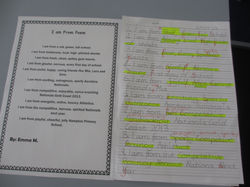 |
 Students showcased fantastic, individual work that met the criteria and relevant AusVELS standards. |
 Peer Assessment Rubric |
Readers Workshops
Sample Readers Workshops: 'Finding out information - Answering literal questions.'
I recently worked with the Prep team at Elsternwick Primary School to implement a range of range of Readers Workshops on the comprehension strategy 'Questioning' that facilitated students' individual inquiries into 'How do living things survive?'. As an essential thinking and learning skill, questioning is crucial to becoming an independent thinker and self-directed learner. As students were working on the inquiry learning asset ‘we are researchers’, the learning intentions centred was 'WALT: find out information'. To enable student success, I clearly articulated the learning intentions and devised literal questions to assist students clarify meanings and locate information in non-fiction texts (print and media). To scaffold students’ learning, I explicitly modelled my thinking processes in shared reading, provided visual aids representing students' prior knowledge and encouraged students to learn from one another as they collaborated in mixed ability groups to find out information. They shared their information on posters which were used as assessment artefacts in addition to ongoing student-teacher conferencing in group work.

Differentiation
To support students' individual needs, interests and learning styles, I use differentiated instruction. To me, differentiation is about tailoring the curriculum to fit the needs of each child based on assessment and my awareness of children's diverse backgrounds, needs, interests, and learning styles. I look at differentiating the curriculum in terms of the content (what children learn), my teaching and children's learning process (the ways students learn and how content is taught) and learning products (how children present or demonstrate their learning, as well as learning environment).
Content, Process & Product
In order to differentiate what children learn, I make sure that I know my students well as individuals and as learners; I use data from a range of assessment sources to create flexible groupings that target children’s individual needs; and, I create open-ended tasks to challenge students at an appropriate level in light of their diverse backgrounds, needs, interests, and learning styles. I have worked with colleagues to create ability-based reading groups using data from Fountas & Pinnell Running Records and ongoing in-class assessment (e.g. in Guided Reading). For example, when working with a focus, ability-based Guided Reading group on one of the workshops on 'questioning', I used a text at their instructional level with a range of images; used explicit teaching strategies such as pre-teaching the needed vocabulary using tactile materials and games (e.g. magnets and 'memory'); and encouraged students to demonstrate their learning verbally and pictorially to help them succeed.
I use ICTs to scaffold students' literacy learning. For example, I recently created an iMovie using images and music from an excursion to Werribee Zoo to provide an audiovisual aid for Prep students' open-ended recount writing and individual inquiries. I also use online resources as an alternative to print texts for reading activities and source programs to enable struggling students. For example, to help support a dyslexic student in his inquiry, I downloaded the ‘Dyslexie’ font and presented clearer information to support his learning.
I am also particularly mindful of supporting EAL students in my classroom. I ensure that I use consistent routines and structures; use visual language; incorporate creative methods to explore language and encourage students to take risks learning language; and engage with students’ home environments.
Catering for student diversity


Questions anchor charts used as visual aids and ongoing measures of assessment throughout unit.
Setting up the Readers Workshop: Promoting positive reading behaviours


Sample Readers Workshop session on 'Finding out information' planner.
Prep reading comprehension strategies.

Example of the literal questions I created to scaffold students' learning and help them achieve the learning intention.

Information presented using the 'Dyslexie' font.


I am always eager to support students with additional needs (including those who speak EAL) and get to know them as individuals as well as learners.